
How to Do a Subscription Audit and Stop Wasting Money on Unused Services
Learn how to do a subscription audit in 5 steps — find every unused subscription, calculate your true monthly waste, and use a free, private tool to stop the leak for good.

The average American spends $219 per month on subscriptions — and 74% of people underestimate that number by more than $100. That's not a budgeting failure. It's an information problem. And a proper subscription audit is the fastest way to fix it.
In this guide, you'll learn exactly how to audit every recurring charge in your life, identify the ones silently draining your account, and use a free, privacy-first calculator to see what that wasted money could actually become if you invested it instead.
What Is a Subscription Audit (And Why You Probably Need One)
A subscription audit is a systematic review of every recurring charge hitting your bank account or credit card — streaming services, apps, gym memberships, cloud storage, software tools, and anything else billed on a repeating schedule.
The reason most people need one: subscription businesses are engineered to be forgettable. Free trials silently convert to paid plans. Annual billing means you pay once and forget for 12 months. Cancellation flows are buried six menus deep. Dark patterns on websites make it deliberately hard to stop paying.
The result? Research shows that 42% of consumers are currently paying for at least one service they no longer use, and the average person wastes around $32/month — roughly $384/year — on forgotten subscriptions. A thorough subscription audit takes under an hour and can recover hundreds of dollars annually.
The Real Cost of Subscription Creep
Before walking through the audit process, it helps to understand why this gets out of hand so quickly.
"Subscription creep" is the gradual accumulation of recurring charges over time. The average person added 2.5 new subscriptions in 2024 while only canceling 1.2 — a net gain of more than one new recurring charge per year. Multiply that across a decade and you're carrying a portfolio of subscriptions many of which you barely remember signing up for.
Here's what makes it especially painful: it's not the cost of any single subscription that hurts. It's the compound drain of 10–15 of them running simultaneously. At $10–$20 each, five forgotten subscriptions = $50–$100 quietly leaving your account every month. Over a year, that's $600–$1,200.
And if you factor in what that money could have been doing in an index fund or a yield-generating account at 7% annual growth? That "small" $100/month waste becomes over $52,000 in 20 years of forgone wealth. That's the real cost of not doing a subscription audit.
How to Do a Subscription Audit: 5 Steps
Step 1: Gather Your Bank and Card Statements
Pull at least 3 months of transaction history from every payment method you use — checking account, all credit cards, PayPal, Apple Pay, and Google Pay. Don't skip anything. Many people have subscriptions spread across multiple cards, which is exactly why they never see the full picture in one place.
Pro tip: Search your statements for keywords like "recurring," "subscription," "monthly," "annual," and ".com" to surface hidden charges quickly.
Step 2: List Every Recurring Charge
Go line by line and write down every charge that appears more than once. Include:
- Service name
- Monthly cost (convert annual charges to monthly equivalents)
- How often you use it
Don't edit yourself at this stage. Just capture everything — even the ones you're sure you need.
Step 3: Rate Your Actual Usage Honestly
This is where most people's audits fall apart: they write down what they intend to use, not what they actually use. Be brutally honest.
For each subscription, ask:
- Have I used this in the past 30 days?
- If I woke up and it was cancelled, would I immediately re-subscribe?
- Am I paying for a premium tier when the free version would be fine?
A good rule of thumb: if you have to think about whether you've used it recently, you probably haven't.
Step 4: Calculate Your Waste Score
Add up the monthly cost of every subscription you rated as "rarely" or "never" used. This is your monthly subscription waste — the amount you're paying for services delivering zero value.
Then project it out: multiply by 12 for your annual waste figure. Then use a compound interest calculator to see what that money would be worth in 10 or 20 years if invested instead. Most people are genuinely shocked by this number.
Step 5: Cancel, Downgrade, or Keep
For each subscription in your "rarely/never" bucket, take action within 24 hours:
- Cancel immediately anything you haven't used in 60+ days
- Downgrade from premium to free tiers where the free version covers your actual needs
- Pause instead of cancel for things you might want seasonally (some services allow this)
- Negotiate — for services you want to keep, call and ask about retention discounts. Many will offer 2–3 months free to keep you.
Where to cancel: Most services bury this in Account Settings → Subscription or Billing. For App Store subscriptions: Settings → [Your Name] → Subscriptions (iOS) or Play Store → Payments & Subscriptions (Android).
The Faster Way: Use the Neo Subscription Leak Calculator
Doing this manually works, but it's tedious. The Neo Subscription Leak Calculator automates the heaviest part of the process — and it's completely free.
Here's what makes it different from other subscription trackers:
🔒 100% Local Processing — Your Data Never Leaves Your Device
Most subscription management apps require you to link your bank account via Plaid or a similar service. That means your financial data goes to a third-party server. The Neo tool works entirely differently: your bank statement is processed client-side in your browser using JavaScript. The file is never uploaded anywhere. No server ever sees your transactions. Once you close the tab, the data is gone.
This is a meaningful privacy advantage. You can verify it yourself — the tool works fully offline after the page loads.
Step 1: Find Your Subscriptions Automatically
Drop your bank statement (PDF, CSV, TSV, or TXT — exported from Revolut, Wise, N26, Chase, HSBC, or any major bank) into the tool. It scans the transactions and automatically identifies recurring charges from known subscription services.
Prefer not to upload anything? There's also a manual mode where you pick subscriptions from a built-in database of 35+ popular services.
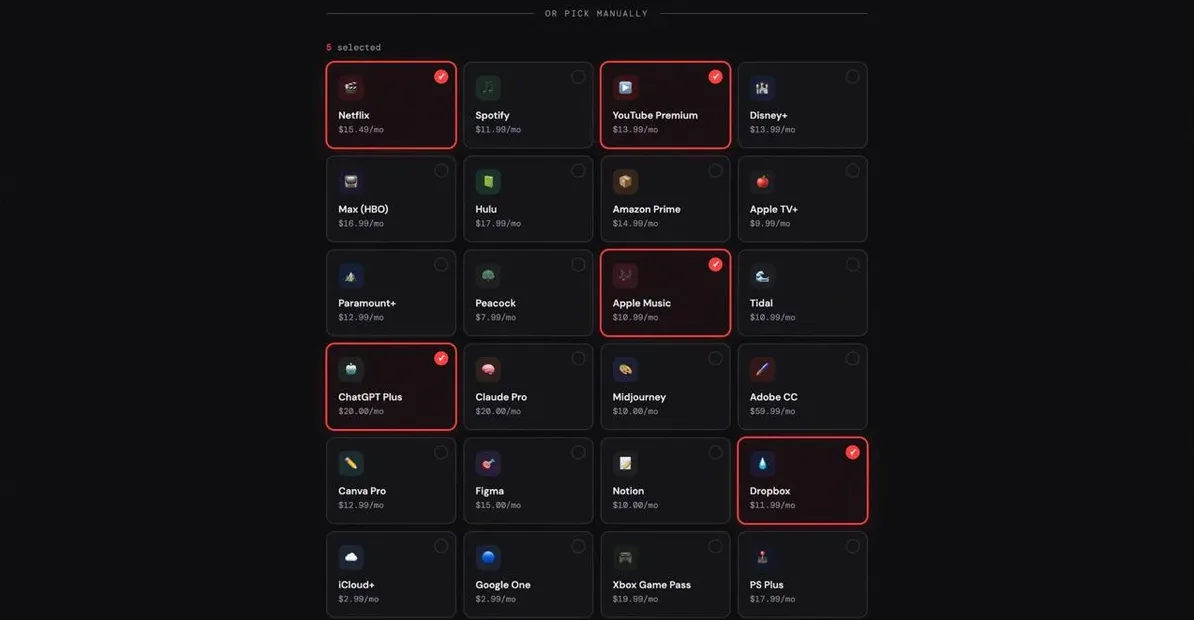
Step 2: Rate Your Usage and See Your Waste Score
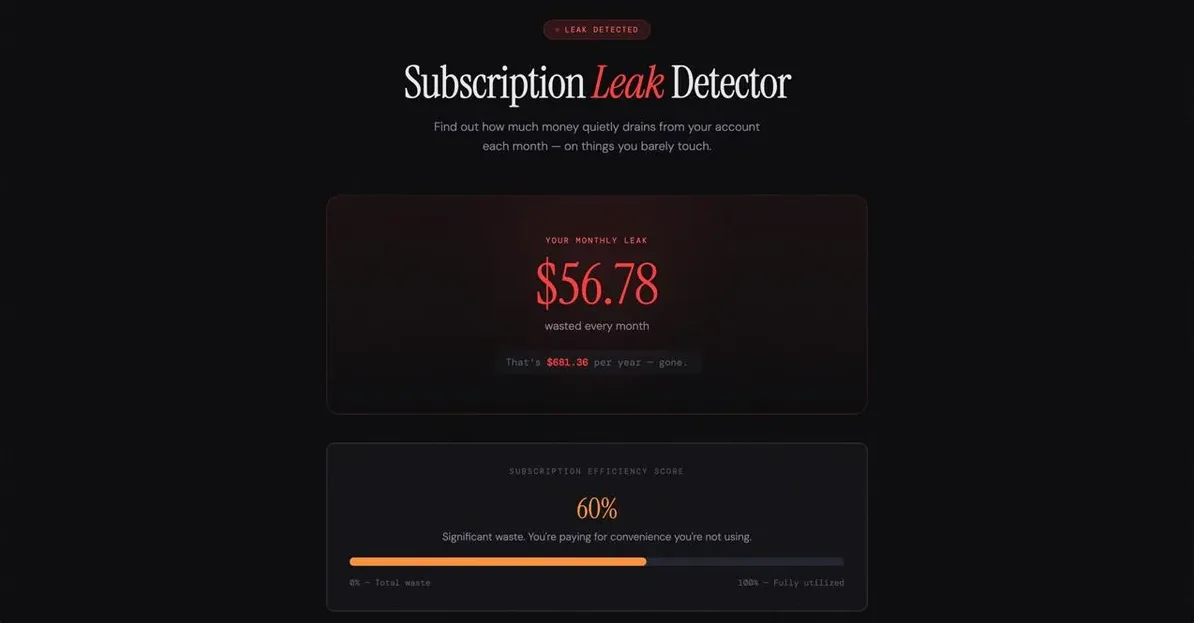
The tool then walks you through each detected subscription and asks you to rate your usage honestly: Daily, Sometimes, Rarely, or Never. Based on your ratings, it calculates:
- Your monthly subscription waste (how much you're paying for things you don't use)
- Your annual waste (the full-year cost of that drain)
- Your subscription efficiency score — a 0–100% rating of how well your subscription spending is actually serving you
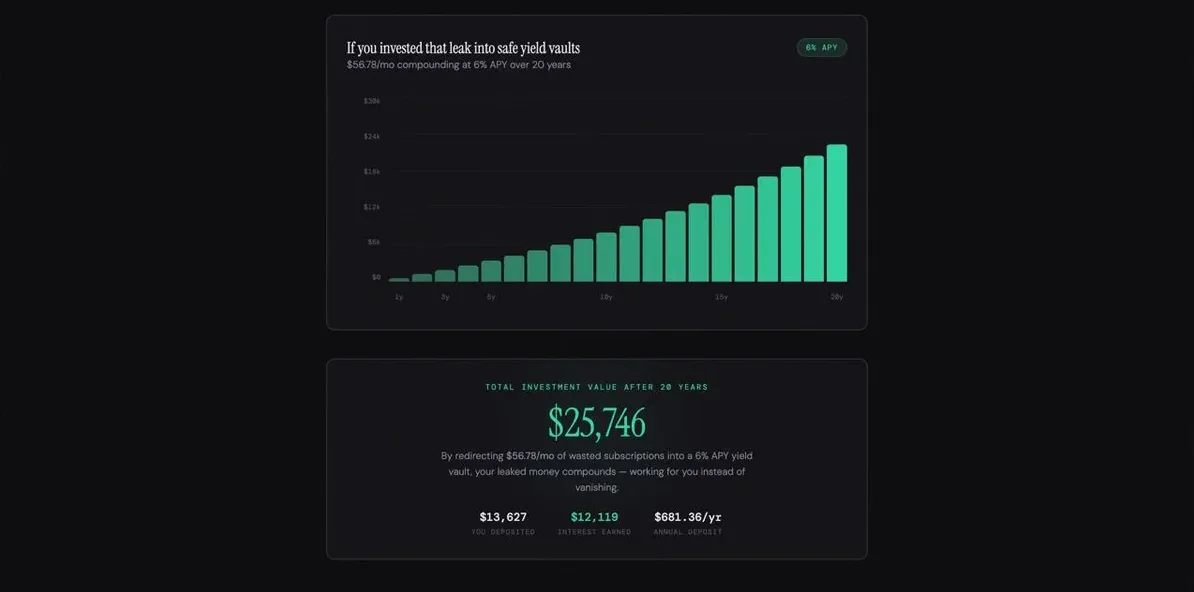
- Your 20-year opportunity cost — what that wasted money would grow to if invested at 7% annual returns
Most users discover they're wasting between $50 and $150/month. The investment projection is the number that tends to stick.

Start your free subscription audit →
Who Should Do a Subscription Audit Right Now
You should do this audit today if any of these apply:
- You haven't reviewed your recurring charges in more than 3 months
- You've signed up for free trials in the past year and aren't sure which ones converted
- You've changed your lifestyle (moved, changed jobs, had a kid) but haven't updated your subscriptions to match
- You feel like your money "disappears" but can't explain where it goes
- You're trying to cut expenses but haven't found obvious places to cut
The audit is especially valuable if you've been a heavy user of free-trial offers. According to consumer spending data, 48% of people have been charged after a free trial they forgot to cancel. That's not forgetfulness — that's a deliberately confusing system. The audit is your countermeasure.
Subscription Audit vs. Subscription Tracking Apps: What's the Difference?
You may have heard of apps like Bobby, Rocket Money, or Trim. These are subscription trackers — they help you log subscriptions and get renewal reminders going forward.
A subscription audit is different. It's a backward-looking exercise: finding and eliminating what's already there before you set up any tracking system.
The right sequence is:
- Audit first — clean house
- Track going forward — prevent creep from returning
The Neo Subscription Leak Calculator is purpose-built for step 1: the audit. It doesn't require an account, doesn't store your data, and delivers results in about 5 minutes.
How Much Could You Actually Save?
Let's look at a realistic scenario.
Say you find five subscriptions you rarely or never use:
- A streaming service: $17.99/month
- A fitness app: $12.99/month
- A cloud storage upgrade: $9.99/month
- A premium news site: $9.99/month
- A software tool you stopped using: $14.99/month
Total waste: $65.95/month — $791.40/year.
If you cancelled all five and invested that $66/month at a conservative 7% annual return:
- In 10 years: ~$11,400
- In 20 years: ~$34,000
- In 30 years: ~$82,000
That's the financial reality behind a 30-minute subscription audit. The Subscription Leak Calculator shows you these projections automatically — not to scare you, but to make the decision concrete.
Frequently Asked Questions
How often should I do a subscription audit?
Most financial experts recommend reviewing your subscriptions every 3–6 months. Major life changes — a move, a new job, a change in household size — are also good triggers. Setting a recurring calendar event every quarter takes about 30 seconds and could save you hundreds.
What's the fastest way to find all my subscriptions?
The fastest method: export 2–3 months of bank or credit card transactions and use the Neo Subscription Leak Calculator to auto-detect recurring charges. Alternatively, search your email inbox for "receipt," "invoice," "billing," or "subscription" to surface confirmation emails from services you may have forgotten about.
Is it safe to upload my bank statement to an online tool?
With the Neo Subscription Leak Calculator, yes — because your statement is processed entirely in your browser and never uploaded to any server. This is meaningfully different from tools that require you to link your bank account via a third-party aggregator. You can verify privacy by disconnecting your internet after the page loads: the tool still works.
How much do most people waste on subscriptions?
Based on 2024–2025 consumer spending data, the average person wastes approximately $32–$50/month on subscriptions they rarely or never use. That's $384–$600/year. Some users discover significantly more waste, particularly those who've accumulated subscriptions over several years without reviewing them.
What's a subscription efficiency score?
The Neo tool calculates a score from 0–100% measuring how much of your total subscription spending is actually delivering value. A 100% score means everything you pay for is used daily. A score below 40% means most of your recurring charges go to services you barely use. Most users score between 50–75%, indicating meaningful room to optimize.
Should I invest the money I save from cancelled subscriptions?
That's exactly what financial advisors recommend. Rather than canceling and simply spending the savings elsewhere, consider automating a transfer of your recovered subscription budget into an index fund or high-yield account. At 7% average annual growth, even $50/month recovered from subscription waste grows to over $26,000 in 20 years. The Subscription Leak Calculator includes these compound growth projections to help you visualize the long-term value.
What banks and statement formats are supported?
The Neo tool supports PDF, CSV, TSV, and TXT formats. Most banks — including Revolut, Wise, N26, Chase, Bank of America, HSBC, and hundreds of others — allow you to export transaction history in at least one of these formats. CSV exports tend to give the cleanest results. You can also skip the upload entirely and pick your subscriptions manually from a built-in database.
The Bottom Line
A subscription audit is one of the highest-ROI financial habits you can build. It takes under an hour, requires no financial expertise, and most people recover $50–$150/month from the first audit alone.
The key is to actually do it — not just intend to.
The Neo Subscription Leak Calculator makes the audit as frictionless as possible: upload your bank statement (or pick manually), rate your usage honestly, and get a clear picture of your waste and what it's costing you long term. No account required. No data leaves your device.
Find your subscription leaks now — it's free and takes 5 minutes →
According to consumer spending research cited by JustCancel.io, 74% of Americans underestimate their monthly subscription spending by $100 or more. A NerdWallet guide on subscription audits recommends quarterly reviews as a core personal finance habit.