
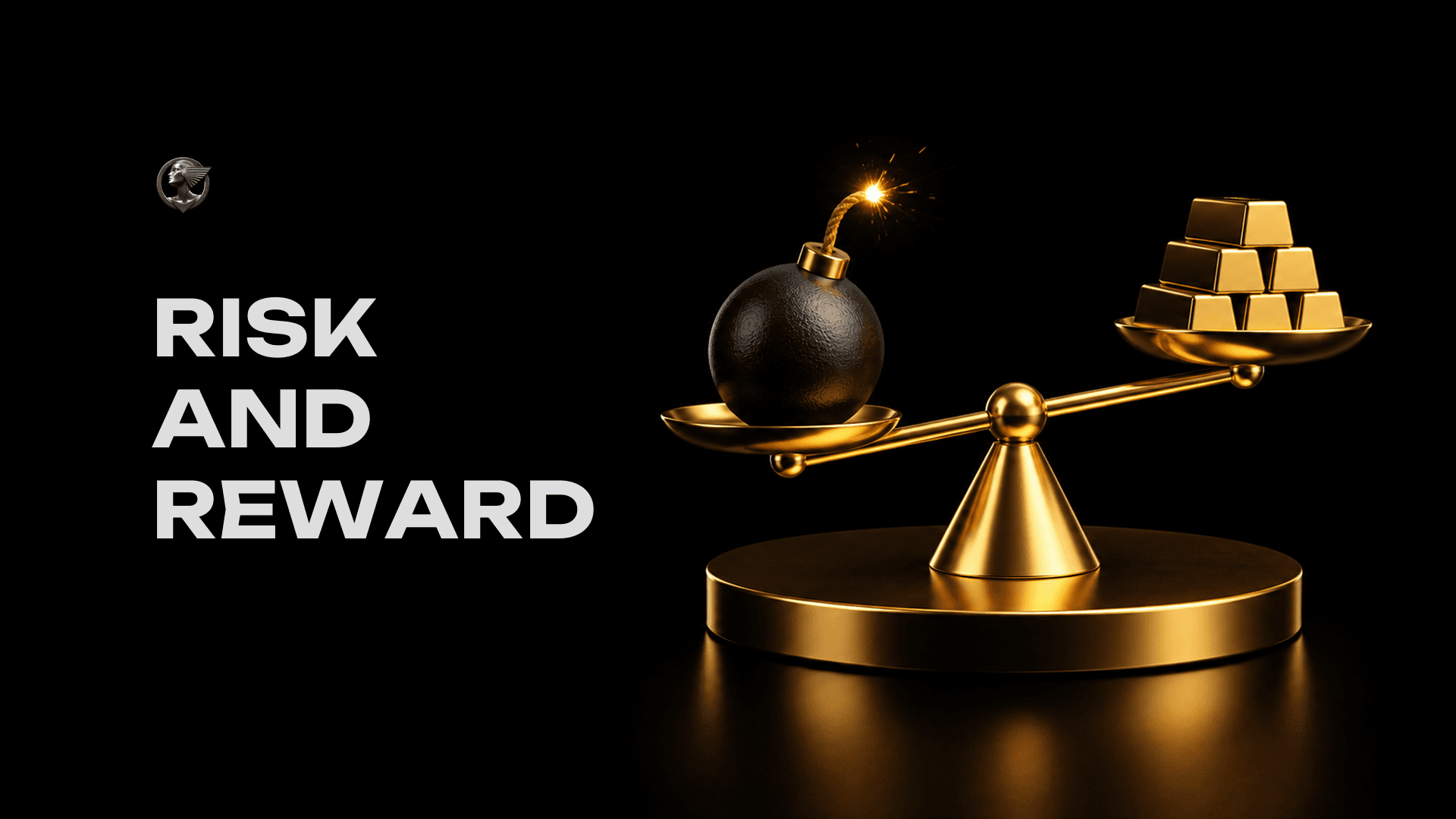
Risk and reward
Why every investment is a trade-off, and the single sentence that protects you from 90% of financial scams.
Every investment is a bet. Some bets are reasonable. Some are not. The thing that decides which is which is risk, and most beginners do not understand it well enough to tell the two apart.
Most people think "risk" means "chance of losing money." That is part of it, but the deeper definition is more useful: risk is the range of possible outcomes. A high-risk investment has a wide range. A low-risk one has a narrow range. The mistake is assuming the only outcomes worth thinking about are the bad ones.
The risk-reward trade-off
There is one rule in investing that holds up across decades, asset classes, and economies. To get higher expected returns, you have to accept more risk. There is no investment that pays high returns with low risk. If there were, everyone would buy it, the price would rise, and the return would shrink until it matched the risk.
This is not a moral statement. It is just how prices work in markets where lots of people are competing. Anything that promises high returns with no risk is one of three things: a misunderstanding, a scam, or a temporary opportunity that will be arbitraged away within hours.
The kinds of risk you actually face
Risk is not just one thing. There are several flavors, and they affect different investments in different ways. Knowing them by name helps you spot which ones you are taking on.
- Market risk: prices can fall. The single most-discussed risk, and usually the least dangerous if your time horizon is long.
- Inflation risk: cash and low-yield assets quietly lose purchasing power over time. The danger of doing nothing.
- Liquidity risk: you cannot sell when you need to. Real estate, private companies, and exotic crypto tokens all have this.
- Credit risk: the borrower defaults. Mostly a bond and lending issue.
- Concentration risk: too much of your money in one place. Owning $100k of one company is much riskier than $100k spread across 50 companies.
- Currency risk: your investment is in dollars but you spend euros. Exchange rate moves cut into your returns.
- Counterparty risk: the platform or institution holding your asset goes under. Highly relevant in crypto.
How much risk should you take?
There is no universal answer. It depends on two things: your time horizon and your stomach.
Time horizon is the harder of the two to argue with. If you need the money in a year, you cannot afford a 30 percent crash. Stocks are a bad idea. If you do not need the money for thirty years, you can ride out almost any crash, and stocks are excellent.
Stomach is more personal. Some people genuinely cannot sleep when their portfolio is down 20 percent, even if they "know" it will recover. That is real, and it matters. The right portfolio is the one you can hold through the worst day, not the one with the best spreadsheet returns.
The "too good to be true" detector
Almost every financial scam in history follows the same template: high promised returns, low described risk, urgency, and either a track record that cannot be verified or a story that explains why this opportunity is special.
Bernie Madoff promised steady positive returns of around 10 percent per year, like clockwork, even in years when markets crashed. The implausibility was never the headline number. It was the consistency. No real strategy makes money that smoothly. He was just paying old investors with new investors' money for decades until the music stopped.
The simplest scam-detector ever: ask "what is the risk?" If the seller cannot articulate it clearly and specifically, walk away. Real investments come with real downsides, and honest people will tell you what they are.
There are old investors and bold investors, but no old, bold investors.
In the next lesson we look at the single best tool ordinary investors have for managing risk: diversification.