
Financial Decision Game: Practice Real Money Choices Before They Cost You
Play the Financial Decisions Game free. Start with $100K in virtual money, face 10 real-life financial dilemmas, and see how your choices affect your portfolio.

Most people learn their biggest financial lessons the hard way — after signing the lease, after swiping the card, after the market tanks their portfolio. Nobody hands you a simulator before your first real financial decision. You just make it, live with the consequences, and (hopefully) remember the lesson.
That's a brutal way to learn.
The good news: there's now a smarter way to stress-test your financial instincts before the stakes are real. The Financial Decisions Game puts $100,000 of virtual money in your hands and hits you with 10 real-life financial dilemmas — the kind you'll actually face in your 20s and 30s. No textbooks, no lectures. Just decisions and consequences.
What Is the Financial Decisions Game?
The Financial Decisions Game is a free, browser-based financial decision making game that simulates real money scenarios. You start with $100,000 in virtual wealth and work through 10 scenarios — each one a genuine dilemma that mirrors decisions adults face every day.
Each scenario gives you two options. You pick one. You see the outcome. Your virtual portfolio grows or shrinks based on your choice. By the end, you have a picture of how your financial instincts actually perform — not how you imagine they do.
The scenarios aren't hypothetical fluff. They're based on real tradeoffs:
- Should you use your savings to pay off high-interest credit card debt, or keep it as an emergency fund earning interest? (The Debt Trap)
- Should you finance a brand-new EV at 0%, or buy a reliable used car outright at a fraction of the price? (The Test Drive)
- Should you keep renting in your 20s, or take on a mortgage when you might move cities in a few years? (The Homeowner Fantasy)
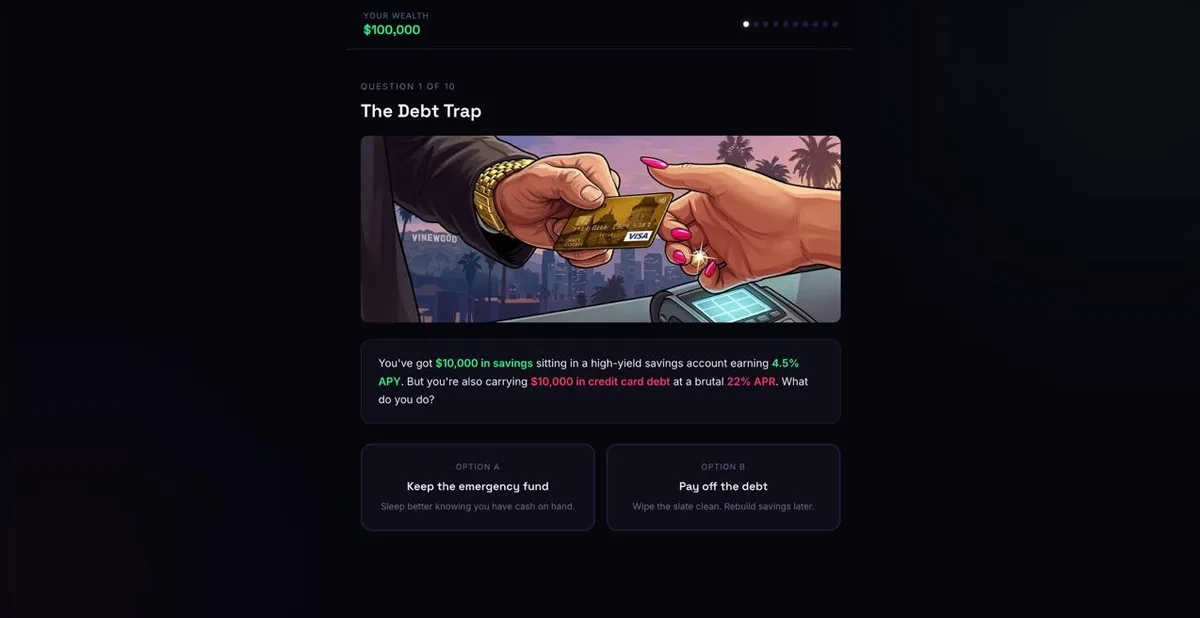
These aren't easy calls. That's the point.
Play the Financial Decisions Game free →
No account required. No credit card. No email signup. Just open it and play.
Why "Learning by Doing" Beats Reading Advice
Here's the thing about financial advice: most people read it, nod along, and then proceed to make the exact same mistake they were warned about. Not because they're careless — because reading about a decision and making a decision are completely different cognitive experiences.
Reading about the cost of carrying credit card debt at 22% APR is information. Being forced to choose between paying it off or keeping your savings — and then watching your portfolio react — is learning. The difference is enormous.
Think about other domains where performance actually matters:
Pilots don't learn to land in a storm by reading about it. They train in flight simulators that throw every scenario at them — engine failure, crosswinds, instrument malfunction — until their responses are automatic. Only then do they take a real plane into real weather.
Athletes don't "understand" pressure situations — they practice them. A basketball player drills free throws under fatigue. A tennis player practices returns under game-point conditions. The practice creates the wiring that fires in the real moment.
Financial decisions work the same way. Your brain doesn't distinguish between a decision made with virtual money and one made under real stakes — at least not when the simulation is well-designed. The feedback loop of: face a dilemma → make a choice → see the consequence creates the same kind of learning your instincts actually retain.
Passive consumption (articles, podcasts, YouTube) has its place. But if you want to improve financial decision making skills, you need practice reps. This is that.
How the Game Works — Step by Step
The mechanics are simple. The thinking required is not.
1. You start with $100,000 in virtual wealth. This is your baseline. Think of it as your financial life, represented as a number.
2. Each scenario presents a real financial dilemma with two choices. The scenarios cover debt management, major purchases, housing, investing, and more. Each option has a brief rationale attached — not a lecture, just enough context to make you think. The interface is sharp, dark-mode, built to feel like a game — not a financial literacy exam.

3. You pick one. The outcome plays out. After each choice, the game shows you what happens to your portfolio. Make the stronger financial decision, your wealth grows. Make the suboptimal call, it contracts. Some outcomes are immediate. Some represent long-term compounding effects — which is actually how real financial decisions work.
4. Repeat for 10 scenarios. By question 3 or 4, a pattern usually emerges. You start to notice whether you're optimizing for safety, for upside, or for the choice that feels right rather than the one that calculates right. That self-awareness is half the value.
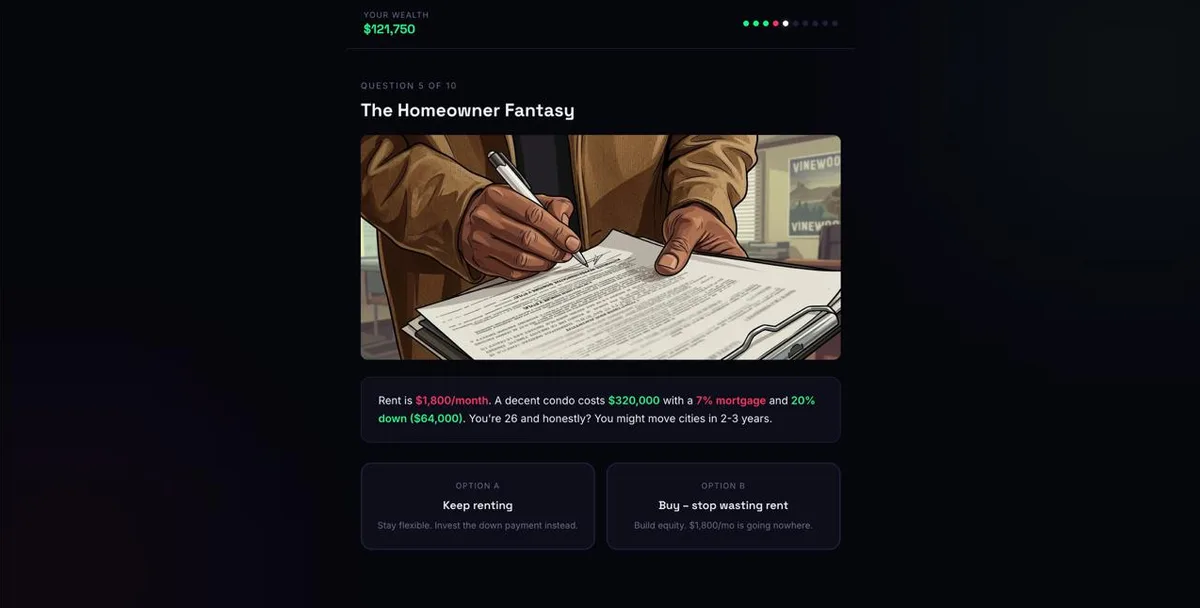
5. See how your portfolio ended up. At the end of 10 decisions, your final wealth score shows where your instincts actually took you. It's surprisingly revealing — especially for people who consider themselves financially savvy.
The whole thing takes 10–15 minutes. It's replayable — try different choices across sessions to see how outcomes shift, and to surface decision patterns you didn't catch the first time. And it's completely free at tryneoapp.com/financial-decisions-game.
Who Gets the Most Out of It?
This is a financial literacy game for adults — not a classroom exercise, not a school assignment. It's built for people who are in, or approaching, the thick of real financial decision-making in 2026.
You'll get the most from it if you fit any of these
- You're facing a real decision soon. About to choose between buying and renting? Thinking about how to handle a chunk of debt versus keeping it as savings? Playing through the scenarios creates mental rehearsal for the actual call — before the pressure is real.
- You know the theory but want to test your instincts. You've read the personal finance classics. You know what compound interest is. But do your gut reactions align with your rational knowledge? There's often a gap — and it shows up quickly in a simulator.
- You've ever hesitated on a big money choice. Most financial paralysis comes from having no reference point — no prior experience making a similar decision under pressure. A financial simulation game gives you that experience at zero real cost.
- You manage money for two people. Couples with different financial instincts often discover why they disagree when they play separately and compare outcomes. It's a surprisingly useful tool for getting aligned before making a joint call.
- You're just curious. Sometimes the best reason to play is to find out where you actually stand — no real stakes, no judgment, just data about yourself.
What most people discover about themselves
Most players go in expecting to do well. They consider themselves reasonably financially literate. And most of them are surprised.
Not always by the wrong answers — but by how they made decisions. Some players notice they consistently choose the option that feels safer, even when the numbers favor risk. Others realize they've been anchoring on headline prices rather than total cost of ownership. A few find out they've been optimizing for the short term without fully registering the long-term cost.
That's the real value of a financial decisions game: not a score, but a mirror. You get to see your own decision-making patterns play out across 10 scenarios, compressed into 15 minutes. That kind of self-knowledge is hard to get any other way — and it transfers directly to real situations.
The Science Behind Gamified Financial Learning
Gamification isn't just about making things fun. When applied to financial education, it's about creating the conditions under which real learning actually happens.
Several studies have examined gamified approaches to financial literacy — and the results consistently show that interactive, consequence-driven learning outperforms passive reading or lecture-based instruction. The reason comes down to decision feedback loops: when a choice is immediately followed by a visible consequence, the brain encodes the lesson at a deeper level than information alone can create.
Two behavioral finance concepts are particularly relevant here:
Loss aversion. Research dating to Kahneman and Tversky shows that humans feel the pain of a financial loss roughly twice as strongly as the pleasure of an equivalent gain. In a simulator, you experience this without real money at stake — you start to notice when you're making choices primarily to avoid loss rather than to maximize value. That pattern, once you see it, is hard to unsee.
Present bias. We systematically overweight immediate payoffs versus future ones. A $64,000 down payment on a condo feels like a massive concrete cost right now. The long-term equity gain feels abstract and distant. A financial simulation game that shows you the long-run portfolio impact of that choice disrupts the present bias — because you see the future consequence immediately, as part of the game's feedback.
Put simply: you can read about these biases all day. Or you can watch yourself fall into them in a low-stakes simulation, learn to recognize the feeling, and catch yourself next time for real.
That's what makes a well-designed personal finance simulator genuinely useful for adults — not just entertaining.
Try It Free — What to Expect
Here's what happens when you click play:
The game opens instantly — no account, no email, no password. The interface is polished and game-like, with dark UI and illustrated scenario art that makes it feel more like a product you'd pay for than a free financial tool.
You'll face 10 dilemmas in sequence. Some will be immediately obvious. Others will have you pausing, second-guessing, doing quick math in your head. A few will genuinely surprise you when the outcome lands — in a good way.
The whole session runs 10–15 minutes if you move at a normal pace. Longer if you sit with each choice.
At the end, your portfolio number tells you how your decisions stacked up. There's no grade, no shame. Just a clear picture of how your financial instincts performed across a realistic range of decisions.
→ Play the Financial Decisions Game free
If you find yourself wanting to take what you practiced into real life, NeoApp is a personal finance app built around the same principle: smarter money decisions, day to day. But start with the game. See where your instincts actually land.
FAQ
What is a financial decision making game?
A financial decision making game is an interactive tool that simulates real-life money decisions in a consequence-driven environment. Rather than reading about financial concepts, you make choices — about debt, purchases, investments, housing — and see how those choices affect your financial position. The goal is to build better financial instincts through practice, not just passive learning.
Is the Financial Decisions Game free?
Yes. The Financial Decisions Game at tryneoapp.com/financial-decisions-game is completely free to play. No account required, no credit card, no signup of any kind. You open it and start playing.
How long does it take to play?
Most players complete all 10 scenarios in 10–15 minutes. The game is designed to be completable in a single session, though you can take as long as you want on each decision. It's also replayable — trying different choices across sessions can reveal a lot about your financial reasoning patterns.
Will this actually improve my real financial decisions?
Research on gamified financial education suggests yes — with an important caveat. A simulator builds the pattern recognition and self-awareness that make better decisions more likely. You start to recognize your own biases (loss aversion, present-day thinking, emotional reactions to risk) in real situations because you've already seen them in a controlled environment. What it doesn't replace is specific advice tailored to your actual financial situation.
What kinds of decisions does the game cover?
The 10 scenarios span the most common and consequential financial decisions adults face: debt management, major vehicle purchases, housing (rent vs. buy), savings allocation, and investment timing. The dilemmas are designed to reflect real tradeoffs — each scenario has a stronger and a weaker choice, and the game shows you which is which and why. That feedback is what makes it genuinely useful for building judgment, not just testing knowledge.